Friday, May 3, 2019

Back to Tourists and more Volcanic Drama


Back to Tourists and more Volcanic Drama
Just the boats at anchor - 3 more were on docks
Independence Park

Crossing to St Christopher & Nevis – the twin island country part of Great Britain, we were plunged back into the flood of cruise ship tourists.  St Kitts, as St Christopher is commonly known, is a favorite cruise ship stop. They are organized in true British fashion to provide the most efficient and enjoyable vacation experience for the cruise ship visitors. On our second day there we watch four mega ships arrive all with in minutes of each other. They currently can only dock three big boys so one anchored out and passengers were ferried from the ship to shore. That added traffic only exacerbated our rolling around in the harbor already uncomfortable with the less than favorable wind direction. While the Port Zante Marina mostly provides docks for concessions to serve the cruise ship passengers, they managed to find us a space for our fat boat and we were able to move inside for a couple nights on a dock with both power and water!  We had not dropped our fenders or lines since leaving Crown Point Marina in St Thomas back in January – I almost forgot how to sling those lines, but Steve slide us up against the wall for a few nights without any rolling about. This gave us ample opportunity to explore St Kitts. 

We got an early taxi to the train station to ride the only functioning railroad in the Caribbean.  This train was built in the early 1900s to transport sugar cane to the processing plants.  The island once had more than 60 mills and stacks to grind and boil the sugar cane. We could see many of the stacks as we approached the island from Statia although most of the windmill structures are in bad repair or have been destroyed by hurricanes.  

old sugar cane rail cars


remains of cane processing plant

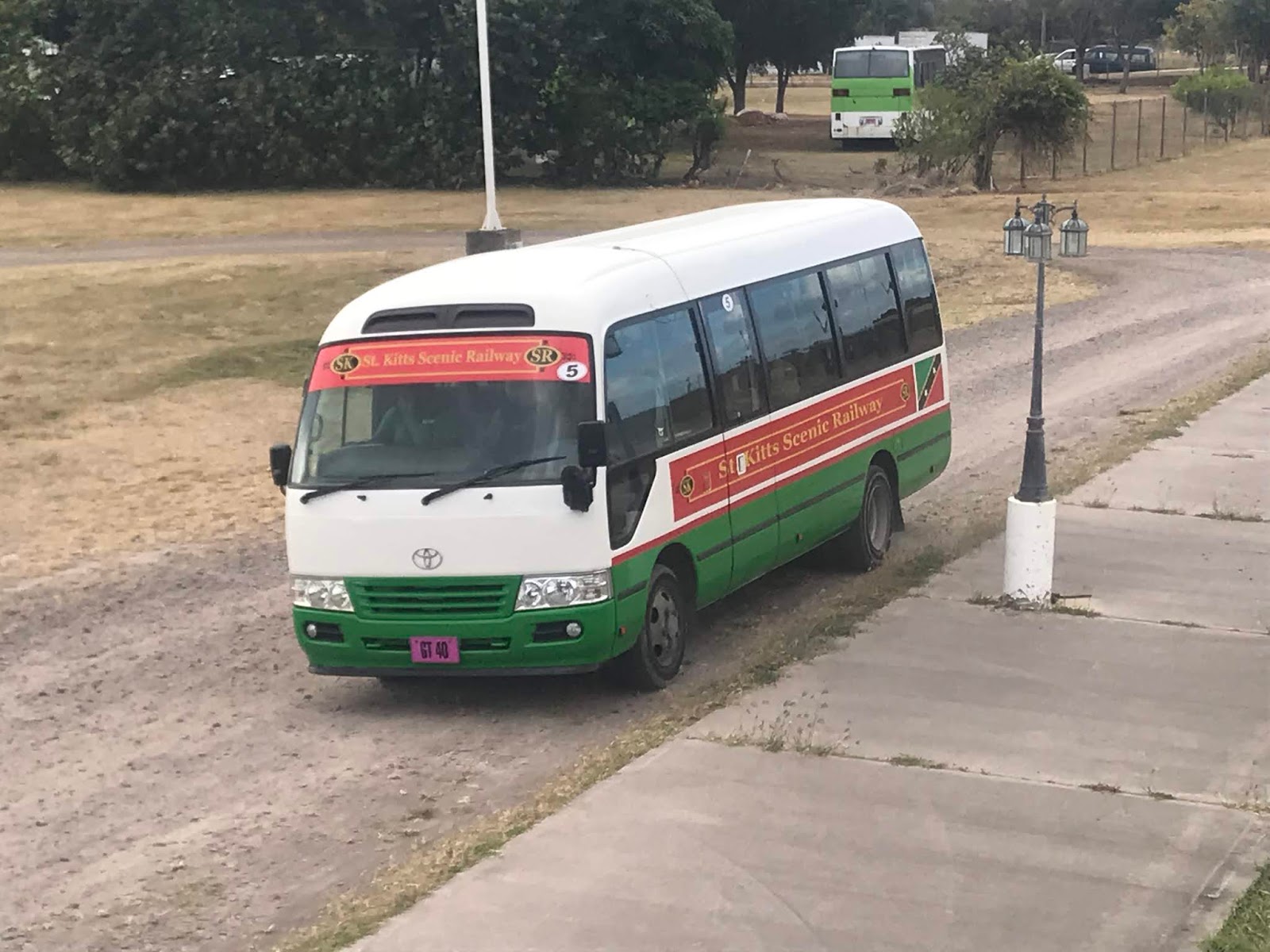
The train winds through the eastern side of the island from the airport area to Sandy Point on the north western tip. Catering mostly to cruise ship clients, they are big into making the trip fun as well as informative.  Bountiful free drinks were provided by a crew of hostesses, a running commentary from Patricia over the loud speakers educated us, and frequent choral interludes by the trio of acapella vocalists entertained us. Free drinks can be a mixed blessing as a few passengers may have over indulged – it was 8:30 in the morning – but overall it was an interesting ride.  The tour ended with a bus ride back to the boats again with running dialogue on the history of St Kitts. 

One interesting point on that tour was the connection with the hymn Amazing Grace.  The author of the text wrote the hymn after surviving a storm at sea. As a result, he found his faith and eventually became ordained and the pastor of one of the churches on St Kitts. (Sorry, I wasn't fast enough to get a photo) We also passed the oldest Anglican church on the island which includes the tomb of Samuel Jefferson, great, great, grandfather of Thomas Jefferson, our 3rd president. The family sold its holdings on fertile St Kitts and moved to Virginia. (That property is now a ruin but has been re-purposed into a batik art factory and botanical garden.)

On another day we arranged a taxi tour to Brimstone Hill Fortress a national park.  This impressive and huge complex took over 100 years to build out between 1690 and 1794. During most of this time St Kitts was divided between the French and the English so the fort was deemed essential to the security of the British side and its other holdings in nearby islands.  The fort was not occupied for almost a 100 years in the last 1800s to mid 1900s until the citizens of St Kitts began to restore and preserve the ruins.  Today it is a magnificent example of sweeping fortifications perched on steep hills with clever engineering and masterful construction.  The Engineers were British soldiers and the labor was done by the St Kitt slaves.


Statia from the fort on St Kitts


Authentic re-en-actors

drain to catch water


We made an afternoon stop in Nevis for a quick trip to walk in the only town there – Charlestown. It has many well-preserved colonial style buildings with the flavor of a town well lived in rather than one primped for tourists.  We enjoyed a beautiful sunset and interesting sunrise for our early start to the next volcano.


early light with a little rain


Monday, April 22, 2019

Statia


Our Second Volcanic island – Saint Eustatius - Statia
A short run from Saba brought us to Statia as Saint Eustatius is known. 

It is another independent island country under the Dutch umbrella, but one with more level land area than Saba.  Statia has several volcanic structures joined by relatively flat land.  This small island nation has a special relationship with the United States since it was the first to recognize and salute our new country back in 1776? 

Orangested is the main town and has two distinct parts – Upper and Lower. The lower town hugs the edge of the harbor between the water and a prominent cliff. It is joined to the upper town by the ancient slave road as well as a more modern road for vehicles. Along this thin strip of lower town are dive operations, restaurants, and a few hotels as well as the busy harbor where freight is regularly off loaded. 
ruins of lower town recently uncovered

old gin house - hotel

Restored Warehouses

The upper town sprawls up the gentle slope of the volcanic hills. The highlight of the old part of upper town includes a restored fort perched on the cliff over the harbor from which that famous salute was fired to recognize the US ship. This formal salute may have been an unintended action and one that eventually drew the wrath of Great Britain, in the end it forged a long-lasting friendship with the young United States that has persisted over the years. The airport is named after one of the Roosevelts
entrance to old slave road


Statia sees far fewer tourists than many of the islands we have visited. There is a large fuel depot operation which seems to sustain the economy more than the tourism. There are two small hotels in lower town – the boutique Old Gin House Inn and the Orange Hotel.  Both seemed to cater to the divers who kept the two dive operators busy.  Steve was also able to get a dive in and saw the Grand Canyon – reputed to be the best dive site on the island. (Not up to Saba but close!)
Our big excursion on Statia was the hike up the Quill – a part of the national park system on the island. This trail was not as manicured as our hike on Saba, nor was it as steep or as long. (This is probably why far more hikers on this trail than on our hike up Saba.) Steve also ventured down into the crater which Julia’s knees refused to do. The views from the rim were worth the effort as was the walk through the rainforest portion of this volcano in the cloud.

land crabs on the path


down in the crater

A highlight of our walk was meeting Brooks, a lovely lady who offered a lift to the start of the track with a stop to tour her garden.  She is a transplant from Dominica and has a major green thumb.  Interestingly most of her garden is in raised planters or pots – she was transporting soil from the lower areas to enrich her planting medium. 

A few boats did join us in the anchorage each night – we spent a week here – but most only stayed overnight or two days at most.  Why so long in this tiny island country? Well Mother Nature dictates often our schedule and then sometimes it is a problem with the boat.  The anchorages at both Saba and Statia were rolly so we deployed our flopper stopper to ease the roll.  For some reason she took to tangling herself and twisted up enough to bend some of the essential parts resulting in a failure of the flopping blades!  We did not want to leave if we could get repairs done in Statia and also we had a great deal of seven nights in the harbor for a mere $30!  So Steve made several trips to the local hardware store and managed to make friends who had friends in the fuel depot machine shop.  Needless to say, our flopper is back in business thanks to the help of Terry and Steve’s ingenuity.
Since Statia has an easy and handy dinghy dock we managed to visit both parts of town and tried several of the restaurants.  The Harbor Club porch was a favorite for the good eats, breeze and view. They also provided the largest loaf of bread we have ever seen and chocolate croissants. Local food was tasted at Franky’s in upper town – recommended by the dive master.  Iced Cappuccino at Para Mira was a reward for the hike up the old slave road. Statia is not a shopping stop – we found one cute shop in the lower town – more notable for the building in which it was located – twin restored old warehouses put to modern uses. However, a week here flew by away from the more touristy bustle of some of our previous stops. For the laid back authentic Caribbean experiences, we can highly recommend both Saba and Statia.


On to the Volcanoes - SABA


On to the Volcanoes - SABA


Our first stop was the Dutch island of Saba.  Very few cruisers visit here since getting to shore can be challenging as well as finding a comfortable anchorage.  The volcanic island comes straight out of the water giving the residents precious little level land and almost zero on the calmer lee side. For hundreds of years cargo had to be ferried to shore in small boats on the rare calm days and then carried up the steep “ladder” steps carved into the hillside. 


We caught a mooring just off this ladder but fortunately nowadays there is a tiny harbor on the south-side with some protection from the surge where the dinghy, ferries and cargo ships can safely dock.  


Much of the water around this steep volcanic island is a protected marine preserve.  Diving here is controlled and must be done with one of the local dive shops.  We lucked into some relatively calm winds and Steve arranged to be picked up for a couple dives.  Since most of the good dive sites are on the lee side, Steve did not have to make the relatively rough run into the harbor, the dive boat picked him up from our mooring!   Steve reports that the pinnacles here are the best diving he has done in the Caribbean. These tall structures are alive with fish and the corals were spared the damage from recent hurricanes.

We did brave the longish, damp dinghy ride to the Fort Bay dock for a tour and hike.  The killer hike is not long in miles but steep – over 1000 stairs – to reach the 2800+ peak. Fortunately, with our hiking sticks to help, we made the 3 hour round trip and returned for lunch and pastries at the Busy B shop in Windwardside.  


The island has two main towns – the Bottom and Windwardside. The Bottom is a steep run up from the docks at Fort Bay and is the first hint of the charm to be found here on Saba.  By law, all buildings on Saba are painted white with green trim and have red roofs. This creates unique and pleasing views from the twisty road. 

This is “The Road Which Could Not Be Built”. For hundreds of years there were only tracks on Saba connecting the villagers here. Back in the mid-1900s engineers from the Netherlands told the residents that a road could not be built for them.  However, one resident, Joseph Lambee Hassel, did not take that answer and taught himself the engineering skills needed to build a road for Saba. Today it is THE ROAD which still twists and turns as it winds around the steep sides of Mt Scenery. 


These intrepid islanders also built an airport when again the Dutch thought it not possible, so today Saba has both a road and an airstrip. The population is small here but the people were very friendly and we enjoyed our road tour with Cornelius and his Cool Cab.


Although scenic beaches are rare here, excellent hiking paths offer endless (if sometimes strenuous) entertainment.  There is also a large medical university in the Bottom which brings students from all over the world to study here on this charming island.
Many years ago, one resident brought the art of lace making back from a trip to Venezuela and taught it to her friends.  So, we had to visit the shop selling their lace to support this beautiful island industry.

We also heard that a new breakwater is in the works which sadly may make this another stop for the massive cruise ships which dump tourists by the thousands on so many of these islands. 

For now, Saba is a remote and special place enjoyed by locals, visited by only very small ships, tourists who stay in the small resorts, and the expat retirees who have discovered this island paradise.
Evidence of our track here and why moorings are helpful